
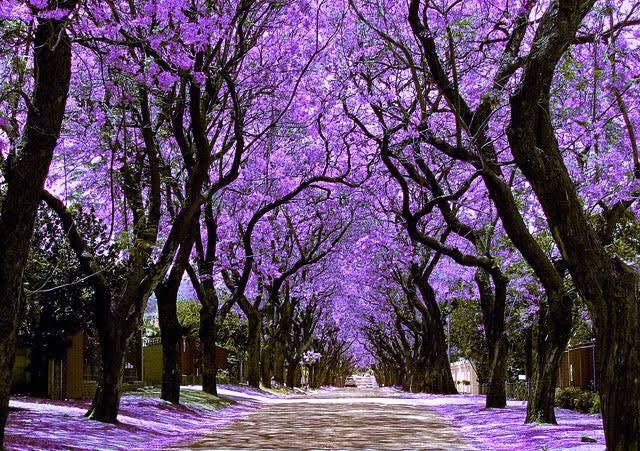
jacaranda rain

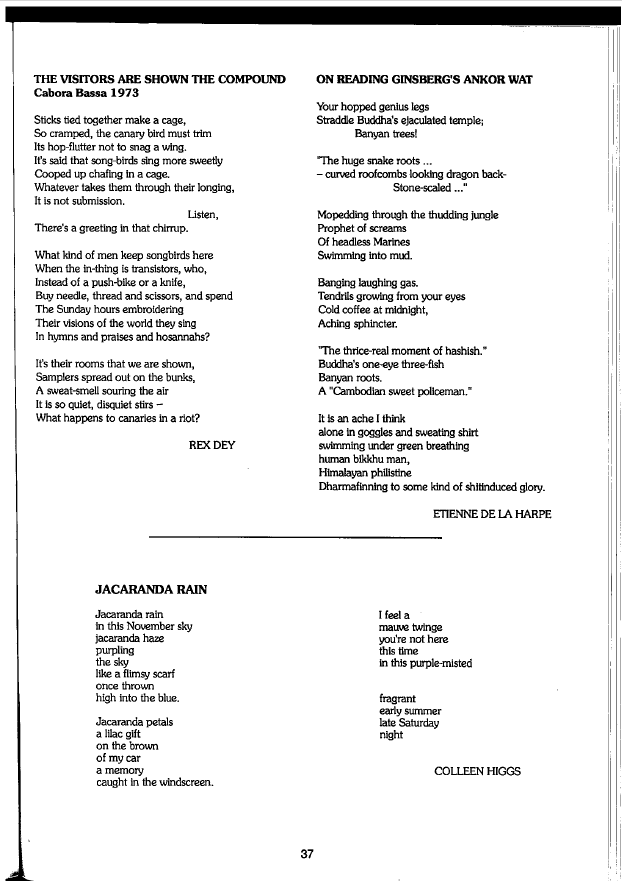
Last week a friend asked me to think back to what it was like for me as a young writer. What encouraged me. I remembered how in 1990, Lionel Abrahams published my poem, “Jacaranda Rain” in Sesame. It was my first time. It was thrilling a delightful secret I hugged close to me. It made me feel like a real writer.
When I told my parents about it, my dad said something like, “Great, good for you. How much will they pay you?” My secret joy felt less cuddly and huggable. Not for a moment had I thought about payment for the poem. And even now, understanding the economics of literary magazines and indeed publishing in South Africa, it wouldn’t occur to me.
I’m not going to say anymore about the payment issue, I could write multiple posts about it. Today I just want to share the poem as it appeared in Sesame. Three poems on the page, mine at the bottom. Thank you to Marike Beyers of the Amazwi Literary Museum in Makhanda for finding it.
Soon jacaranda season will be upon us, and as I live in Cape Town now, I won’t witness it.
Another note, when I published my first collection, Halfborn woman, I didn’t include this poem, it felt too naive or vulnerable perhaps. However, when Marike sent me this page of poems, it was like seeing an old friend again. Ah there you are, my jacaranda poem.
****
I’d love to hear from you about what encouraged you to keep writing.
As I read this on another continent in the early hours of the morning, I smile to myself. Jacarandas. And you, my friend. How wonderful.
Hello Colleen nice to meet you here.
What kept me writing?
I started writing when I migrated from South Africa, where I grew up and lived until I was 13 to Italy my enstranged native country. I wrote poems in those days, all collected in a thick notebook with a light green cover on which a naïf watercolor illustration of a typical British countryside landscape was the furthest image I could relate to.
Writing was an act of resistence to the choice my family made to migrate, an act of resistence to a new life I struggled to adjust to, where no one was ready to acknowledge where I came from, of that particular geography ( that I called "home") so entrenched with history of oppression.
I continued to write despite all the negativity surrounding me on how I would make a living with it.
I write because I have to. I still consider writing and reading an act of resistance.